Perfume has always been more than just a pleasant smell. It is closely connected to personal identity, culture, memories and the way people express themselves. From traditional Arabian attars to modern luxury fragrances, the world of perfumery has developed into an industry with countless fragrance styles, ingredients and application methods.
Among these different fragrance formats, perfume oil has maintained a special place. It is particularly popular in the Middle East, where concentrated fragrances, oud, musk and traditional oil-based perfumes have been part of the fragrance culture for generations.
But what exactly is perfume oil? Is it the same as essential oil? How is it different from ordinary spray perfume? What ingredients are used to make it, and why do some people prefer it over alcohol-based fragrances?
Whether you are discovering perfume oils for personal use, exploring the world of Arabian fragrances or considering starting a perfume business, understanding how these products work can help you make better decisions.
In this guide, we will explain everything you need to know about perfume oil, including its composition, different types, fragrance characteristics, applications and the factors that influence its quality.
What Is Perfume Oil?
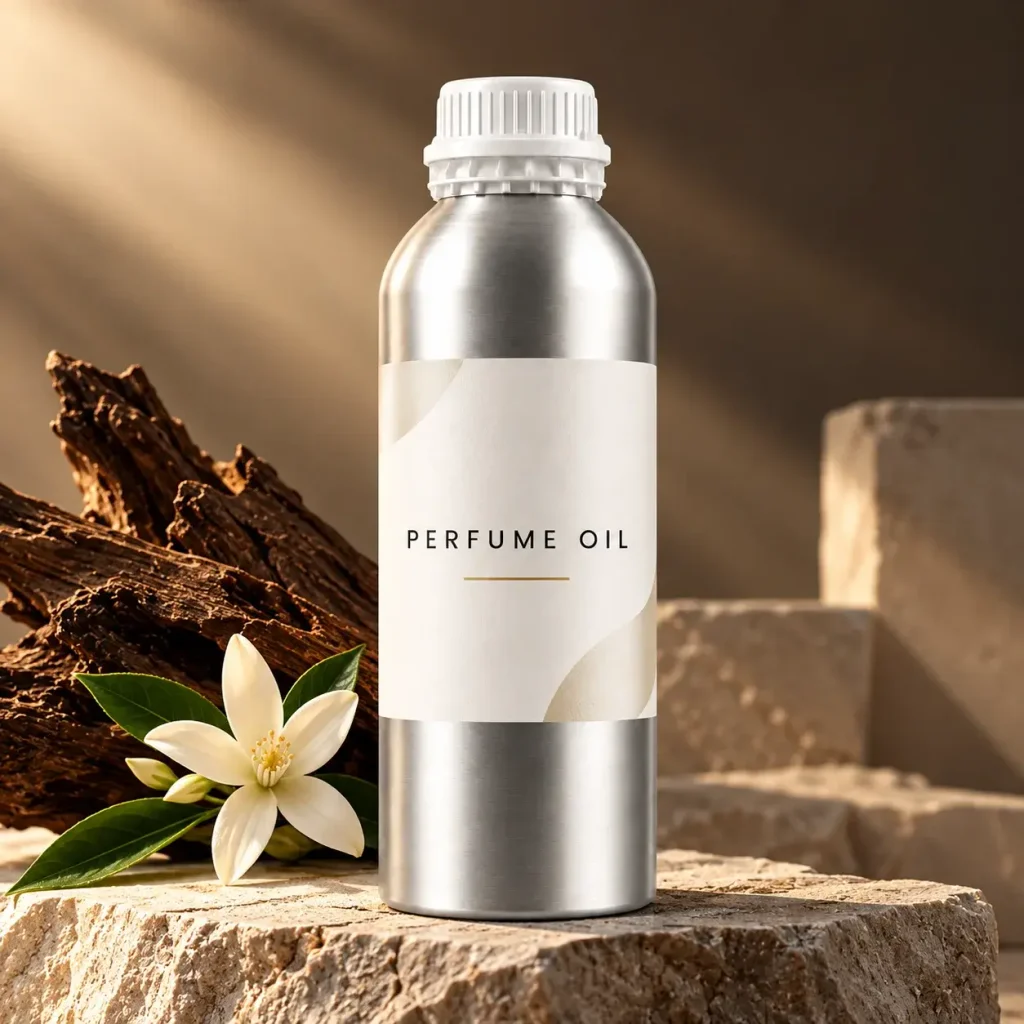
Perfume oil is a fragrance product in which aromatic ingredients are carried in an oil-based formulation rather than being primarily dispersed in an alcohol-and-water base.
Depending on the product, it may contain a carefully developed blend of natural aromatic extracts, synthetic fragrance ingredients, aroma compounds and a suitable carrier oil.
Unlike conventional spray perfumes, which commonly use alcohol as their main solvent, finished wearable perfume oils are generally applied directly to the skin using a roller, dropper or applicator.
The term can also refer to concentrated fragrance compositions supplied to perfume manufacturers and businesses for further formulation. These concentrates are not necessarily ready for direct application to the skin.
This distinction matters because not every product sold as perfume oil has the same composition, concentration or intended application.
For example:
- A wearable perfume oil is formulated for application as a finished fragrance product.
- A concentrated fragrance oil may be intended for use as an ingredient in perfume production.
- A traditional attar is an oil-based fragrance associated with established perfumery traditions, particularly in South Asia and the Middle East.
Although these products share similarities, they should not automatically be treated as interchangeable.
At its simplest, perfume oil is about delivering fragrance through an oil-based format, offering a different application experience from conventional alcohol-based spray perfumes.
How Is Perfume Oil Made?
The production of perfume oil involves combining aromatic materials to create a balanced fragrance composition and, where required, incorporating that composition into an appropriate carrier.
The process can vary considerably depending on the fragrance style, intended application and manufacturing approach.
However, most modern perfume oil production involves several important stages.
1. Selecting the fragrance ingredients
The first step is choosing the aromatic materials that will create the desired scent.
Perfumers work with a broad range of ingredients, including:
- Floral materials such as rose, jasmine and ylang-ylang.
- Woody materials such as sandalwood and cedarwood.
- Aromatic materials such as lavender and rosemary.
- Spicy materials such as cardamom, cinnamon and clove.
- Musk and amber-style fragrance materials.
- Fruity, fresh, citrus and aquatic fragrance ingredients.
Some materials are obtained from natural sources, while others are produced synthetically.
Modern perfumery uses both approaches. Synthetic ingredients are not necessarily inferior to natural ingredients; they can provide consistency, stability and fragrance characteristics that are difficult to achieve using natural materials alone.
The selection depends on the desired fragrance profile, performance, cost, availability and intended product application.
2. Developing the fragrance composition
Once the ingredients have been selected, they are combined in carefully measured proportions.
This is where the creative and technical sides of perfumery come together.
A perfumer may spend considerable time adjusting different ingredients to achieve the desired balance between freshness, sweetness, warmth, depth and overall character.
For example, a woody fragrance might combine sandalwood-style notes, cedarwood accords, amber materials and musk.
A floral fragrance might bring together rose, jasmine, orange blossom and soft musky elements.
The goal is not simply to combine ingredients that smell pleasant individually. The ingredients must work together as a complete fragrance.
3. Choosing the appropriate carrier
For a finished wearable perfume oil, the fragrance composition may be incorporated into a suitable carrier oil.
Common carrier options in oil-based personal fragrance formulations can include:
- Jojoba oil.
- Fractionated coconut oil.
- Other suitable cosmetic-grade carrier oils.
The carrier plays an important role in the finished product. It influences texture, spreadability, application and the overall feel on the skin.
Not every perfume oil uses the same carrier. Some concentrated fragrance products are supplied without a ready-to-use carrier because they are intended for further manufacturing.
This is one reason why understanding the intended application is essential before purchasing a fragrance oil.
4. Blending and quality checks
After the ingredients and carrier have been selected, the formulation is blended according to the intended product specifications.
Depending on the formulation, additional time may be needed for the fragrance to settle and for the manufacturer to evaluate its overall character.
Quality checks can include:
- Appearance and clarity.
- Fragrance consistency.
- Odour profile.
- Compatibility with the intended packaging.
- Stability under appropriate storage conditions.
- Relevant safety and documentation checks.
For commercial production, these checks help ensure that the finished product meets the manufacturer’s quality requirements.
5. Packaging the finished product
The final stage involves selecting appropriate packaging.
Finished perfume oils are commonly available in small glass bottles, roller bottles, dropper bottles and other suitable containers.
Packaging is not just about appearance. It must also be compatible with the formulation and provide appropriate protection during storage and use.
For businesses developing a fragrance collection, the choice of packaging can influence product presentation, customer experience and brand identity.
What Are the Main Types of Perfume Oil?
Perfume oils are available in a wide variety of fragrance styles. Some are inspired by traditional Arabian perfumery, while others follow contemporary fragrance trends.
Understanding the different categories makes it easier to identify the right type for personal use or commercial applications.
1. Arabian Perfume Oils
Arabian perfume oils are closely associated with the fragrance traditions of the Middle East.
They often feature rich and distinctive fragrance profiles built around materials such as oud, amber, musk, rose, saffron and woody accords.
These fragrances are frequently appreciated for their depth and character.
Some are warm and sweet, while others are smoky, woody, spicy or floral.
Arabian-style perfume oils are popular among people who enjoy bold fragrance compositions and traditional Middle Eastern scent profiles.
2. Oud Perfume Oils
Oud is one of the most recognisable materials in Middle Eastern perfumery.
Traditionally, natural oud oil is associated with aromatic material obtained from certain Aquilaria trees after the formation of resinous heartwood.
The resulting aroma can vary depending on factors such as origin, processing and quality.
Natural oud is often described through woody, smoky, resinous, earthy and complex scent characteristics.
Modern perfumery also uses oud accords and synthetic ingredients to create different interpretations of the oud fragrance profile.
It is important to distinguish natural oud oil from an oud-inspired fragrance composition. They are not necessarily the same product.
3. Musk Perfume Oils
Musk is another important fragrance family used in both traditional and contemporary perfumery.
Modern musk fragrances can range from soft and clean to warm, powdery and sensual.
White musk-style compositions, for example, are often associated with fresh, clean and understated fragrance profiles.
Musk ingredients are also used in combination with floral, woody and amber materials to add softness and depth to a fragrance.
4. Floral Perfume Oils
Floral perfume oils are developed around the character of flowers.
Popular floral fragrance profiles include:
- Rose.
- Jasmine.
- Lily.
- Tuberose.
- Orange blossom.
- Violet.
- Ylang-ylang.
Some floral fragrances are light and fresh, while others are rich, creamy and intense.
They can be worn individually or combined with woody, fruity and musky accords to create more complex compositions.
5. Woody Perfume Oils
Woody fragrances are built around materials and accords associated with wood, roots, bark and earthy aromatic characteristics.
Common examples include sandalwood, cedarwood, vetiver and patchouli-inspired profiles.
These fragrances can be warm, dry, creamy, smoky or earthy depending on the composition.
Woody perfume oils are frequently combined with amber, musk and spices to create deeper fragrance profiles.
6. Designer-Inspired Perfume Oils
Designer-inspired perfume oils are developed around fragrance styles that reflect popular preferences in contemporary perfumery.
They may feature fresh citrus, sweet vanilla, aromatic woods, floral notes, musk or combinations of these elements.
These products are often attractive to fragrance retailers and businesses looking to offer customers a broad selection of familiar fragrance styles.
However, a designer-inspired fragrance should be described accurately. It should not be presented as an original branded product or imply an affiliation with another fragrance house without authorization.
Perfume Oil vs Alcohol-Based Perfume: What Is the Difference?
One of the most common questions among fragrance enthusiasts is whether perfume oil is better than conventional spray perfume.
The answer depends on personal preference, fragrance formulation and how the product is intended to be used.
Both formats have their advantages.
The main difference is the medium used to deliver the fragrance.
Traditional spray perfumes commonly use alcohol as their primary solvent. Wearable perfume oils use an oil-based formulation.
Here is a comparison:
| Feature | Perfume Oil | Alcohol-Based Perfume |
|---|---|---|
| Base | Suitable carrier oil or oil-based formulation | Usually alcohol-based |
| Application | Roller, dropper or applicator | Spray |
| Fragrance release | Generally more gradual | Often has a noticeable initial release |
| Projection | Often closer to the skin | Can create a wider scent trail |
| Application quantity | Usually a small amount | Typically a few sprays |
| Portability | Often available in compact bottles | Available in different bottle sizes |
| Fragrance experience | More intimate application | More diffusive application |
Does perfume oil last longer than spray perfume?
Perfume oils are often marketed for their longevity, and many people enjoy the way their fragrance develops on the skin.
However, there is no universal rule that every perfume oil lasts longer than every spray perfume.
Longevity depends on several factors:
- The fragrance composition.
- The concentration of aromatic ingredients.
- The volatility of the materials.
- The carrier or solvent system.
- The application method.
- Individual skin characteristics.
- Environmental conditions.
For example, a fragrance rich in certain woody, musky and amber materials may remain noticeable longer than a composition dominated by lighter citrus materials.
But a well-formulated alcohol-based perfume can also offer impressive longevity.
The better approach is to evaluate each fragrance individually rather than assuming that the oil format always performs better.
Does perfume oil project less than spray perfume?
Generally, many oil-based wearable fragrances create a more intimate scent experience.
They are often applied in small amounts to specific areas rather than sprayed into the air.
Alcohol-based sprays can disperse fragrance more widely during application, which may produce a more noticeable initial scent trail.
That does not mean every perfume oil has weak projection. Formulation, concentration and ingredient selection all influence how a fragrance develops and how noticeable it becomes.
Why Do People Prefer Perfume Oils?
There are several reasons why perfume oils continue to attract fragrance enthusiasts.
A different fragrance experience
Perfume oils offer an alternative to conventional spray perfumes.
Their application is more controlled, and many people appreciate having a fragrance that sits relatively close to the skin.
This can be particularly appealing to those who prefer a more personal fragrance experience.
Convenient application
Many perfume oils come in compact roller bottles or small applicator containers.
These formats are easy to carry in a handbag, travel pouch or everyday essentials kit.
A small quantity is often sufficient for application, depending on the product’s formulation.
Strong connection with traditional perfumery
In the Middle East and South Asia, oil-based fragrances have a long-standing cultural connection.
Traditional attars, oud oils and concentrated aromatic compositions continue to be appreciated by people who enjoy classic fragrance styles.
For many consumers, perfume oil represents more than an alternative to spray perfume. It is also part of a wider fragrance tradition.
A wide variety of fragrance profiles
Modern perfume oils are not limited to traditional woody or musky fragrances.
They are available in floral, fruity, fresh, sweet, spicy, oriental-inspired and contemporary fragrance profiles.
This variety makes them suitable for different preferences and occasions.
How to Apply Perfume Oil Correctly
Using perfume oil is relatively simple, but a few practical considerations can improve the experience.
1. Start with a small amount
Perfume oils are often applied in small quantities.
Use the roller or applicator to apply a modest amount rather than covering a large area.
You can always adjust the amount based on the product’s intensity.
2. Apply to suitable skin areas
Common application areas include:
- Wrists.
- Behind the ears.
- The sides of the neck.
- Other suitable pulse-point areas.
Always follow the product’s directions and avoid applying fragrance to irritated or broken skin.
3. Allow the fragrance to develop
Once applied, give the fragrance time to develop.
The first impression may differ from the scent you experience after several minutes.
This is because different aromatic materials evaporate and develop at different rates.
4. Avoid rubbing aggressively
There is no need to vigorously rub your wrists together after applying perfume oil.
Simply allow the fragrance to settle naturally on the skin.
5. Be careful around clothing
Some perfume oils may leave marks on delicate or light-coloured fabrics.
It is generally better to apply the product to suitable skin areas and allow it to settle before getting dressed.
If you want to apply fragrance to clothing, check the product instructions and test fabric compatibility in an inconspicuous area first.
6. Check product suitability
Not every fragrance concentrate is suitable for direct skin application.
Some concentrated fragrance oils are intended exclusively for manufacturing applications and require further formulation.
Always check the supplier’s instructions, product documentation and applicable safety information before use.
What Is the Difference Between Perfume Oil, Essential Oil and Fragrance Oil?
These three terms are often used interchangeably in everyday conversations, but they refer to different things.
Understanding the distinction is particularly important if you are purchasing fragrance materials for personal use or perfume manufacturing.
Perfume Oil
Perfume oil generally refers to a finished oil-based fragrance intended to be worn on the skin.
It may contain a combination of aromatic ingredients incorporated into a suitable carrier.
Its purpose is to provide a complete fragrance experience.
Essential Oil
An essential oil is an aromatic material obtained from a natural source, usually through processes such as steam distillation or mechanical expression.
Examples include:
- Lavender essential oil.
- Peppermint essential oil.
- Eucalyptus essential oil.
- Lemon essential oil.
- Frankincense essential oil.
Essential oils are individual aromatic materials or natural mixtures of aromatic constituents.
They can be used as ingredients in perfumery, but an essential oil is not automatically a finished perfume.
Natural origin also does not automatically mean that an ingredient is safe to apply undiluted to the skin.
Fragrance Oil
Fragrance oil generally refers to a formulated mixture of aromatic ingredients developed to create a particular scent.
It may contain natural materials, synthetic aroma chemicals or a combination of both.
Fragrance oils can be developed for different applications, including fine fragrance, personal care, home fragrance and other consumer products.
The intended application is important because a fragrance designed for one product category may not be suitable for another.
For example, a fragrance concentrate intended for a candle formulation should not automatically be assumed to be suitable for a wearable perfume.
Quick comparison
| Product | What it means | Common purpose |
|---|---|---|
| Perfume oil | Finished oil-based fragrance | Personal fragrance |
| Essential oil | Aromatic extract from a natural source | Ingredient in perfumery and other applications |
| Fragrance oil | Formulated blend of aromatic ingredients | Perfume and other product manufacturing |
For manufacturers and fragrance businesses, asking for the technical specifications and intended application is much more useful than relying on the product name alone.
What Determines the Quality of Perfume Oil?
Not all perfume oils are created equal.
Two products may belong to the same fragrance category but offer very different experiences.
Several factors influence the overall quality of a perfume oil.
1. Quality of aromatic ingredients
The materials used in a fragrance composition play a major role in its overall character.
The selection, purity, consistency and compatibility of ingredients all matter.
A balanced fragrance composition requires more than simply using expensive materials. The ingredients must work together to create the intended scent.
2. Fragrance balance
A well-developed fragrance should have a coherent character.
The opening, development and dry-down should complement one another rather than feel disconnected.
The fragrance should also suit its intended purpose and target audience.
3. Formulation
The carrier and overall formulation influence the texture, application and stability of a finished wearable perfume oil.
A suitable formulation should be developed with the intended product category in mind.
4. Batch consistency
Consistency is particularly important for commercial buyers.
Imagine launching a perfume collection and discovering that a fragrance smells noticeably different when you reorder it.
That can create problems for customer satisfaction, product reviews and repeat purchases.
Businesses should therefore ask suppliers about batch controls, product specifications and the processes used to maintain consistency.
5. Stability and storage
Fragrance products can change over time due to factors such as heat, light, oxygen exposure and unsuitable packaging.
A quality-focused manufacturer should consider appropriate storage and packaging conditions and evaluate product stability.
6. Documentation and safety
For products intended for skin application, safety information and suitable documentation are essential.
Businesses should request relevant technical documents, usage recommendations and applicable fragrance safety information from their suppliers.
A professional approach to quality goes beyond how pleasant a fragrance smells when first opened.
How Should Perfume Oil Be Stored?
Proper storage can help maintain the quality of perfume oil over time.
Fragrance compositions may be affected by environmental conditions, particularly excessive heat, direct sunlight and prolonged exposure to air.
Here are some practical storage recommendations.
Keep perfume oils away from direct sunlight.
Store bottles in a cool, dry location away from windows and direct sunlight. Prolonged light exposure can contribute to changes in fragrance composition.
Avoid excessive heat.
Do not leave perfume oils inside a hot vehicle or near heat-producing appliances.
High temperatures can accelerate changes in certain fragrance ingredients.
Keep bottles properly sealed.
Close the cap after each use to limit unnecessary air exposure and reduce the possibility of leakage or contamination.
Choose suitable packaging.
Packaging should be compatible with the formulation and provide appropriate protection during storage.
Follow the manufacturer’s recommendations.
Storage requirements can vary between formulations. Always follow the product’s specific instructions rather than assuming that every perfume oil has the same shelf life.
Is Perfume Oil Suitable for Starting a Perfume Business?
Perfume oils can be an interesting product category for entrepreneurs exploring the fragrance market.
The category offers opportunities across retail, wholesale distribution, private-label products and perfume manufacturing.
However, choosing the right products and understanding the intended application are important before starting.
Here are some considerations for aspiring perfume entrepreneurs.
Understand your target customers
Are you planning to sell traditional Arabian fragrances, contemporary designer-inspired profiles, oud-based products or a broader fragrance collection?
Your target customers will influence the products, packaging and price positioning you choose.
Decide between finished products and fragrance concentrates
This is one of the most important decisions.
If you want to sell ready-to-use roll-on perfumes, you need suitable finished formulations.
If you intend to manufacture your own perfume products, you may need fragrance concentrates and additional formulation materials.
These are different purchasing requirements.
Evaluate samples before bulk purchasing
Before committing to larger quantities, request samples where available.
Evaluate the fragrance profile, consistency, intended application and relevant documentation.
For businesses planning repeat orders, it is also worth discussing how the supplier maintains consistency between batches.
Consider packaging and presentation
Packaging influences how customers perceive a fragrance brand.
Roll-on bottles, glass containers, labels, caps and outer packaging should all align with the brand’s positioning.
Think about long-term supply
A fragrance business needs reliable access to products.
When comparing suppliers, consider availability, communication, product consistency, commercial terms and the ability to support future orders.
For businesses operating in Dubai or sourcing for international markets, these considerations are particularly important when planning a sustainable product range.
Frequently Asked Questions About Perfume Oil
1. What exactly is perfume oil?
Perfume oil is an oil-based fragrance product containing aromatic ingredients. Finished wearable perfume oils are generally formulated with a suitable carrier, while concentrated fragrance oils may be supplied as ingredients for further manufacturing.
2. Is perfume oil the same as essential oil?
No. Essential oils are aromatic extracts obtained from natural sources. Perfume oils are fragrance products that may combine multiple natural and synthetic aromatic ingredients with a suitable base.
3. Is perfume oil alcohol-free?
Many finished wearable perfume oils are formulated without alcohol as their primary base. However, formulations can differ, so it is always best to check the product specifications.
4. Does perfume oil last longer than spray perfume?
Some perfume oils offer long-lasting fragrance experiences, but performance depends on the ingredients, concentration, formulation, application and environmental conditions. There is no guarantee that every perfume oil will outlast every spray perfume.
5. Can perfume oil be applied directly to the skin?
Finished wearable perfume oils may be designed for direct skin application, subject to their instructions and safety information. Concentrated fragrance oils intended for manufacturing should not automatically be applied directly to the skin.
6. What are the most popular perfume oil fragrance types?
Common fragrance categories include oud, musk, amber, floral, woody, fresh, fruity and Arabian-inspired compositions. Preferences vary between consumers and markets.
7. Can perfume oil be used to make spray perfume?
Some concentrated fragrance oils are developed for use in alcohol-based perfume formulations. However, compatibility, formulation, solubility and permitted usage levels must be checked before manufacturing.
8. What is the difference between attar and perfume oil?
Attar is a traditional term associated with oil-based perfumery, particularly in South Asia and the Middle East. Perfume oil is a broader term that covers a wider range of modern oil-based fragrance products.
9. How should perfume oil be stored?
Keep perfume oil in a properly sealed container, away from direct sunlight, excessive heat and unnecessary air exposure. Follow the manufacturer’s storage recommendations.
10. Are perfume oils suitable for wholesale purchasing?
Yes. Perfume oils and fragrance concentrates are used by retailers, distributors, perfume manufacturers and private-label businesses. The appropriate product depends on the intended application, quantity and commercial requirements.
Final Thoughts: Understanding Perfume Oil Before Choosing the Right Fragrance
Perfume oil is an important part of the modern fragrance industry, combining traditional oil-based perfumery with contemporary fragrance development.
From Arabian attars and oud compositions to floral, musky and designer-inspired profiles, the category offers a wide variety of fragrance experiences.
However, understanding the differences between finished perfume oils, essential oils and concentrated fragrance materials is essential.
For individual consumers, it helps in choosing the right fragrance and using it appropriately. For perfume entrepreneurs, retailers and manufacturers, it provides a foundation for evaluating products, selecting suitable materials and building a fragrance collection.
Whether you are exploring perfume oils for personal interest or developing a commercial fragrance business, the most important starting point is understanding the product, its formulation and its intended application.
Exploring Perfume Oils for Your Business?
If you are a perfume retailer, distributor, manufacturer or fragrance entrepreneur looking to explore different fragrance profiles, PerfumeOilDubai.com provides a starting point for discussing wholesale and bulk perfume oil requirements.
Our fragrance categories include:
- Designer-inspired perfume oils.
- Arabian perfume oils.
- Oud and musk oils.
- Concentrated perfume oils.
- Perfume body oils.
- Roll-on perfume oils.
- Fragrance oils for perfume making.
Whether you are expanding an existing product collection or developing a new fragrance concept, our team welcomes enquiries from businesses in Dubai, across the UAE and internationally.
Looking for perfume oils for your business?
Explore our perfume oil range at PerfumeOilDubai.com or contact our team directly on WhatsApp to discuss your requirements.
WhatsApp: +971 52 791 5802
Share your preferred fragrance categories, intended application and approximate quantities, and we can discuss the available options for your business.
Editorial note: Fragrance formulations and permitted applications vary. Always consult the relevant product documentation and applicable safety guidance before using concentrated fragrance materials in finished consumer products.
1 thought on “What Is Perfume Oil? A Complete Guide to Concentrated Fragrances”